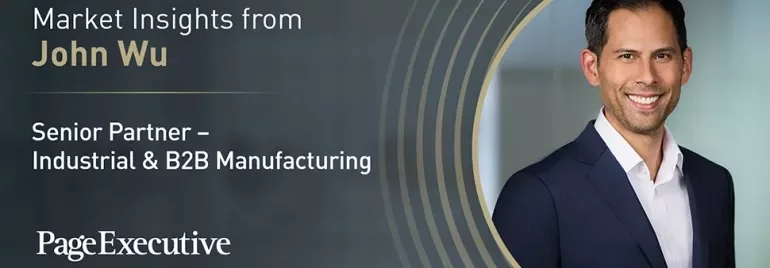
Tell us about your practice and areas of focus.
For the last 12 years, I`ve been dedicated to the Industrial Manufacturing and Mobility space, developing a strong track record placing P&L owners and Functional Leaders across public, private, and private equity backed organizations, ranging from small/mid- market companies to global Fortune 500s.
My work centers on partnering closely with executive teams, to identify leadership that can navigate complexity, drive operational excellence, and accelerate transformation.
What’s important for your practice heading into 2026?
Going into 2026, maintaining a strategic, consultative partnership with clients remains essential. In addition, the ability to stay agile and responsive as client needs and business conditions continue to shift rapidly, driven by macroeconomic forces, geopolitical uncertainty, labor market dynamics, and evolving customer expectations.
Since COVID, the pace of change has intensified. More than ever, clients need partners who can anticipate disruption, adapt quickly, and guide them through ambiguity with confidence.
Supporting organizations through this volatility and advising them on leadership strategies that build resilience and long-term competitiveness will be critical.
What changes in the industry have had the biggest impact on your work?
AI continues to be a major point of discussion, but one of the most meaningful shifts I’ve seen is the intensifying focus on data-driven decision-making. While this isn’t new, the gap between companies that do it well and those that struggle has become much more visible.
In commercial functionals, for example, leaders increasingly tell us they need to move beyond traditional relationship-based selling. Customer relationships still matter, but without bringing insights and value backed by data, organizations risk being left behind. Purchasing teams today expect evidence, transparency, and measurable impact.
On the manufacturing side, data integrity has become a critical issue. We recently placed a COO and a Senior Plant Director with a $5B industrial business. When the Plant Director stepped into their top performing facility, he discovered that much of the plant’s data was inaccurate, despite strong performance metrics. That triggered a broader data audit across the organization, reinforcing how fundamental accurate information is for operational excellence.
Companies want leaders who can not only consume data but challenge it, validate it, and use it to drive continuous improvement.
What emerging skills are employers seeking in your practice?
Across the board, employers are looking for leaders who are deeply data-driven and process-oriented. People who can interpret information, translate it into action, and execute effectively in complex environments.
It’s less about one specific “hot” role and more about a foundational skillset:
- Comfort working with data and using it to guide decisions
- Ability to operate within matrixed, global organizations
- Resilience and adaptability in the face of constant change
- Strong process discipline paired with strategic thinking
Technical trends come and go, but leaders who can bring structure, clarity, and data-guided decision-making to evolving industrial environments remain in consistently high demand.
What advice would you give candidates looking to stand out?
First, do your homework. Not just on the company, but on the broader industry and ecosystem. Even if you’re already working in a similar space, being prepared with a strong understanding of market dynamics and business implications immediately elevates your credibility. It signals that you care, that you prepare, and that you can connect dots beyond your functional area.
Second, treat every person in the interview process with equal respect. Senior executives often meet future peers during interviews, and while those peers may not make the final hiring decision, they influence it heavily.
A strong example: if a CEO is hiring a Chief Commercial Officer to accelerate innovation, the relationship between the CCO and the CTO or VP of R&D becomes essential. The same applies to HR. CHROs and HR leaders are strategic partners, and candidates who discount them often raise red flags about how they would function within a leadership team.
How you show up in the hiring process reflects how you will show up inside the organization.